
Vinyl Fence Installation Lake Norman NC
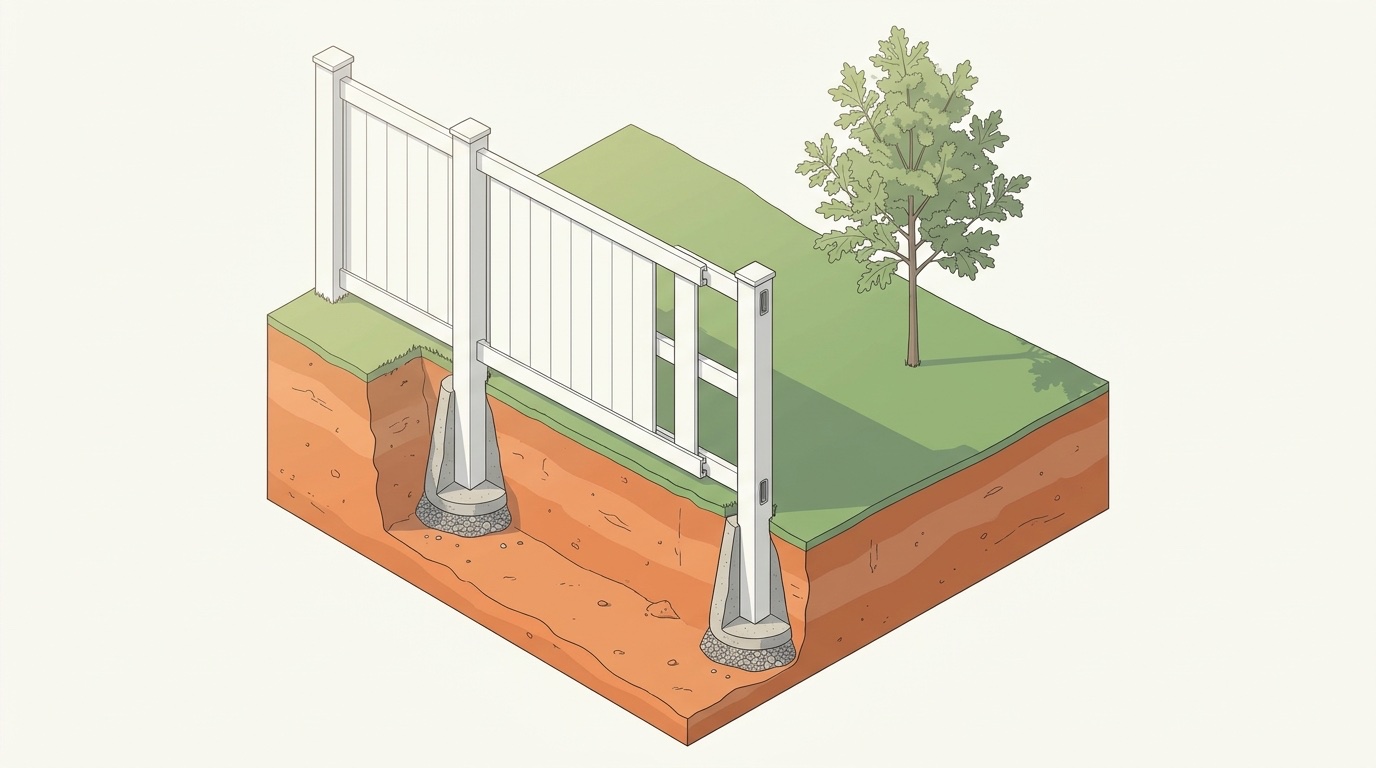
The PVC in a vinyl fence does not rot, rust or need paint, so how long a vinyl fence installation lasts around Lake Norman is decided by the installation itself: how deep and how wide the posts are set, how the gate posts are built, and how much room each rail was given to change length. Get those three right and the plastic is rarely the part that ends the fence. Get them wrong and a perfectly good material bows, leans or drags within a few summers.
This guide is about those three decisions, with the numbers behind them. It does not repeat prices; those live in our North Carolina fence cost guide.
Key takeaways
- Rigid PVC expands at 3.0 × 10⁻⁵ in/in/°F (JM Eagle technical bulletin, January 2009). An 8-foot rail changes length by about 0.2 inches across a 70°F swing.
- NOAA's 1991–2020 normals for Charlotte Douglas Airport run from a 31.8°F average January low to a 90.3°F average July high, and those are shaded air readings, not a rail in afternoon sun.
- The routed pocket where a rail enters a post is the expansion joint. A rail pushed tight to the back of that pocket on a cold morning has no room left in July.
- ASTM F964 sets the quality of the vinyl profile, but its own scope says it does not address wind load. Wind and ground movement are handled by posts, footings and spacing.
- Ask for two warranties in writing: the manufacturer's material warranty and the installer's workmanship warranty. They cover different failures.
The temperature range a Lake Norman fence works through
Start with the weather, because it sets every other number in this article. NOAA's National Centers for Environmental Information publishes 30-year climate normals for the Charlotte Douglas Airport station (USW00013881). In the 1991–2020 monthly normals, January's average daily low is 31.8°F and July's average daily high is 90.3°F. That is a spread of 58.5°F between two monthly averages, before you count a cold snap below the average or a heat wave above it. Our guide to the best fence types for Mooresville and Huntersville homes plans around a 25°F to 95°F working swing.
There is a second reason the real range is wider than the normals. Weather stations read air temperature in a shaded, ventilated shelter. A fence rail on the west side of a Cornelius backyard at four in the afternoon is not in a shelter. It is in the sun, and on a south or west run it will spend summer afternoons warmer than the forecast says.
Rigid PVC changes length, and the rail joint is where that goes
Vinyl fence is rigid PVC, and PVC is a thermoplastic. JM Eagle's bulletin The Effects of Temperature on PVC Pipe gives its coefficient of thermal expansion as 3.0 × 10⁻⁵ inches per inch per degree Fahrenheit, and notes that in long, slender PVC parts the change in length is the one you notice. A fence rail is exactly that kind of part. Multiply the coefficient by a rail span and a temperature swing and you get the table below.
| Length of PVC | 58.5°F swing (Charlotte Jan low to Jul high normal) | 70°F swing (25°F to 95°F) | 100°F swing (sun-heated rail) |
|---|---|---|---|
| 6 ft rail (72 in) | 0.13 in | 0.15 in | 0.22 in |
| 8 ft rail (96 in) | 0.17 in | 0.20 in | 0.29 in |
| 150 ft of rail laid end to end (1,800 in) | 3.16 in | 3.78 in | 5.40 in |
The last row is the one worth sitting with. A 150-foot backyard run is not one long rail, but if it were, it would grow by nearly four inches across a 25°F to 95°F swing. Breaking the run into post-to-post sections spreads that movement across many small joints so no single one has to absorb it. The bulletin's own rule of thumb lands in the same place: allow three-eighths of an inch of length change for every 100 feet of PVC for each 10°F change.
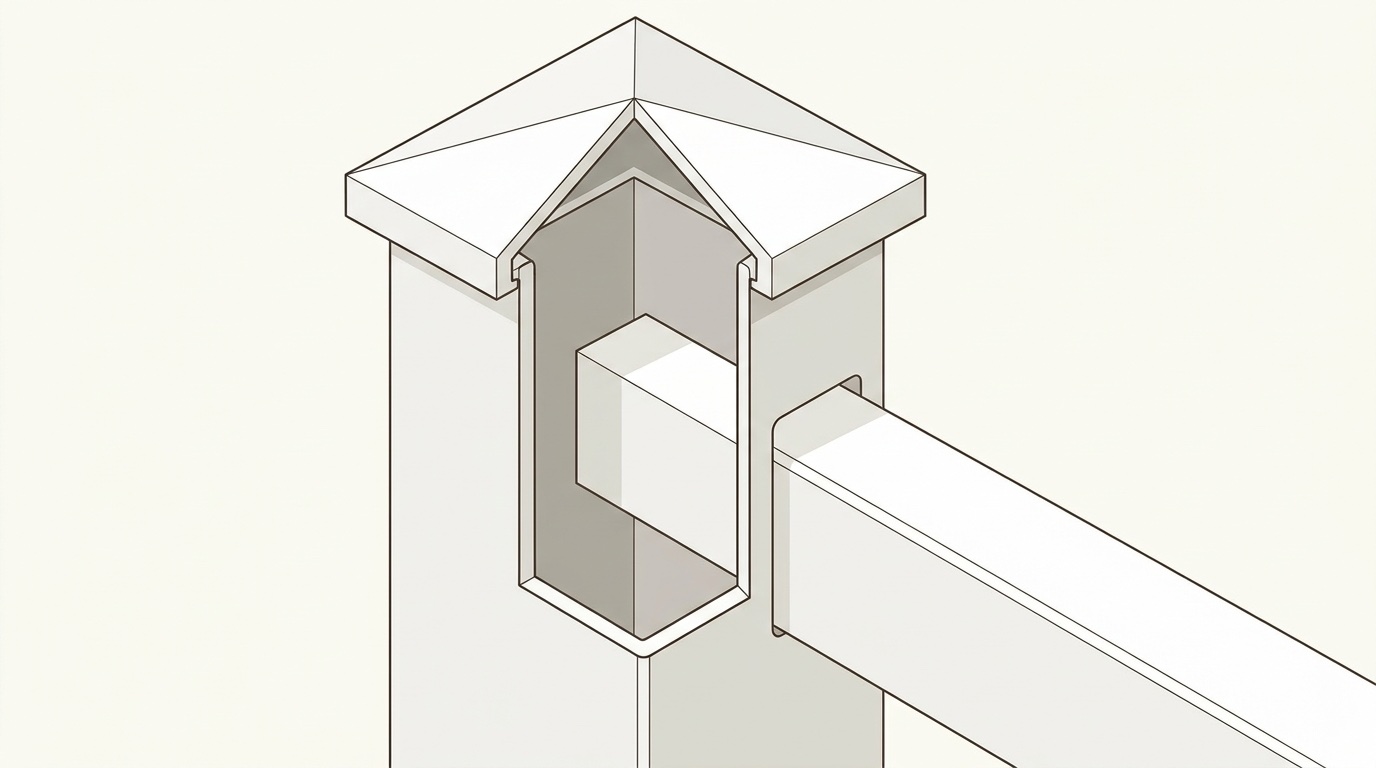
On a routed-rail vinyl fence the rail is not glued into the post. It slides through a hole routed in the post wall and floats. The depth left inside the post is the only place a summer rail can go. If that room is used up, the rail still expands, and the easiest way for it to find length is to bow sideways between two posts.
A rail cut tight in January has no room in July
Here is the scheduling detail that matters to anyone installing between November and March. A rail is at its shortest on a cold morning. If it is cut and pushed hard to the back of its pocket so the joint looks snug to the homeowner standing beside it, the crew has fitted it at the coldest length it will have all year. Every day warmer than install day, the rail is longer than the space it was given.
That does not make winter a bad time to put in a vinyl fence. It means the clearance has to be set for the temperature on install day rather than for how the joint looks. The same bulletin adds a second cold-weather note: PVC gets stiffer as it gets colder and more flexible as it warms. Stiffness is not the same measurement as impact resistance, so read that as a reason to handle and cut vinyl with care on a frosty morning, not as a number.
The diagnostic for a fence that is already up follows from the same physics. If the bowed sections sit on the sun-facing runs while the shaded run under the pines stays straight, the problem is thermal and the posts are probably fine. If a run is leaning out of plumb, or every side is moving regardless of sun, you are looking at the ground rather than the plastic.
What ASTM F964 covers, and the load it hands back to the installer
Vinyl fence profiles are made to a published standard. ASTM F964-13(2024), Standard Specification for Rigid Poly(Vinyl Chloride) (PVC) Exterior Profiles Used for Fencing and Railing, sets requirements for dimensional tolerances, extrusion quality and weatherability, and it allows the profile to be a single homogeneous extrusion or a coextrusion of two or more PVC compounds in layers. Its notes also point installation guidance away from the standard itself, to the manufacturer or to a separate ASTM practice. Then it says plainly what the specification does not do.
Loadbearing characteristics for fence and railing assemblies are not addressed within this specification (for example, windload, horizontal or vertical guardrail loading).ASTM F964-13(2024), Scope, Note 2
A six-foot solid vinyl privacy section is a flat panel with nothing for wind to pass through. ASTM F964 does not tell you how much wind that section will take once it is standing in a yard. That is set by the post embedment depth, the footing diameter, the post spacing and whether gate posts are reinforced. Two fences built from identical, fully compliant profiles can behave very differently in the same storm. The standard buys you a consistent piece of plastic. The installation buys you a fence that stays up.
Where a vinyl fence gives out before the vinyl does
Posts in wet clay. The Piedmont's red clay holds water, and a post set too shallow or with too little concrete in that soil can lean long before any panel is damaged. We covered what an auger actually passes through, and why footing shape matters, in our guide to fence installation in Huntersville.
Gate posts. A gate is the one part of a fence built to move, and its post carries a swinging load every time it opens. Sag shows up first as a latch that needs lifting. Gate posts need their own footing and reinforcement spec, which is why we treat gates as a separate conversation from the fence line.
Sun-facing runs. Thermal bow, as described above, on the elevations that take afternoon sun, when the rail joints were fitted without clearance.
The surface. Color retention depends on the UV stabilizers in the compound, and ASTM F964 includes weatherability among the properties it specifies. That makes fading a product question, answered by the warranty on the specific product line you are quoted, rather than an installation question.
Sloped lots and stick-built runs
Many lots around the lake are sloped, and a rigid vinyl panel does not bend to follow the ground. That is why our vinyl fence installation page describes every vinyl job as stick-built on site by our crews to fit the terrain, with concrete-set posts. In practice that means the run is assembled post by post in the yard rather than dropped in as finished panels, so each section's height can be set against the grade it actually stands on. It is slower than hanging panels on a level lot, and on a real slope it is the difference between a fence that follows the yard and one with triangles of daylight underneath it.
When a slope is steep enough to be moving, a fence cannot fix it. Posts set along the crest of an unsupported bank follow the soil as it sheds in heavy rain, and the run leans out of plumb. That problem sits below the fence, and it is a grading or retaining question to settle before the posts go in.
If the answer is a wall, build it before the fence and plan the fence around it. Carolina Custom Stone and Hardscape builds gravity and Geo-Grid reinforced retaining walls for sloped and lakefront lots around Lake Norman, with drainage behind every course. On a reinforced wall, ask the builder where the Geo-Grid and drainage sit behind the face before anyone sets fence posts along the top. Settle the wall that holds the grade first, then lay out the fence line knowing where the reinforcement and drainage sit, rather than digging post holes through them afterwards.
Lifespan is two warranties, not one
"Lifetime warranty" is a phrase homeowners often hear first, and on our vinyl page it refers to the manufacturer's material warranty. Material warranties are about the product. The installation is covered separately: the same page lists a 10-year work warranty from us. Those two documents answer different questions, and a quote that only mentions one of them is incomplete.
Before signing with anyone, ask for the actual warranty documents for the actual product line and read four things: who issues the material warranty today, whether coverage transfers if you sell the house, how fading is defined and measured, and what the exclusions say about wind and ground movement. Then check that the quote states, in numbers rather than adjectives:
- Post embedment depth and footing diameter, in inches, separately for line posts and gate posts.
- Whether gate posts are reinforced, and on which gates.
- Post spacing, and how a long run is broken into sections.
- The exact product line and profile, so the warranty on paper matches the fence in the yard.
- The length of the workmanship warranty and what it covers.
If you are still choosing between materials, cedar asks for a stain refresh every three to four years in this humidity and aluminum is not a privacy fence; our materials guide lays out the trade-offs. If you are ready to talk about a specific yard, request a free on-site estimate or call (704) 778-4122.
Frequently asked questions
How long does a vinyl fence last around Lake Norman?
The vinyl itself does not rot or rust, so the lifespan is set by the installation. Post depth and footing size in wet clay, gate post reinforcement and rail clearance for the temperature swing decide whether a fence is still straight years later. Manufacturer lifetime warranties cover the material, not the workmanship, so ask for both warranties in writing.
How much does a vinyl fence rail expand in North Carolina summer heat?
At PVC's coefficient of 3.0 × 10⁻⁵ in/in/°F, an 8-foot rail grows about 0.17 inches across the 58.5°F gap between Charlotte's average January low and average July high, and about 0.29 inches across a 100°F swing on a rail sitting in full sun.
Why is there a gap where the vinyl rail goes into the post?
That space is the expansion joint. The rail floats in a routed hole in the post, and the room left inside is where the rail goes as it lengthens in summer. A joint with no clearance at all on a cold day is the one more likely to bow later.
Is it OK to install a vinyl fence in winter?
Yes, as long as rail clearance is set for the cold-day length of the rail rather than pushed tight for looks. PVC is at its shortest and stiffest on a cold morning, so a rail fitted snug in January has used up the room it needs in July.
Does ASTM F964 mean a vinyl fence is rated for wind?
No. ASTM F964 covers the vinyl profile itself, including dimensions, extrusion quality and weatherability. Its scope note says load-bearing characteristics of fence assemblies, wind load among them, are not addressed. Wind resistance comes from post depth, footing size, spacing and reinforcement.
Can a vinyl fence follow a sloped yard?
Yes, when the run is built to the grade. A stick-built vinyl fence is assembled post by post on site so each section can be set to the ground it stands on. If the slope itself is unstable, deal with grading or a retaining wall before the fence goes in.
What warranty should a vinyl fence installation come with?
Two. A manufacturer's material warranty for the vinyl and a written workmanship warranty from the installer. Read who issues the material warranty, whether it transfers when you sell, how fading is measured and what it excludes, and check how many years the workmanship warranty runs.
Planning a fence in the Lake Norman area?
Get a written, itemized quote — usually within 48 hours. We handle permits, HOA review, and shoreline approvals.
Get my free estimateMore local guides

Fence Installation in Lake Norman: A 2026 Local Homeowner's Guide
Permits, HOA rules, soil, and lakefront setbacks — everything Lake Norman homeowners should know before installing a fence in Mooresville, Cornelius, Huntersville, or Davidson.
How Much Does a Fence Cost in North Carolina? (2026 Pricing Guide)
Real installed price ranges per linear foot for wood, vinyl, aluminum, and chain link in the Charlotte / Lake Norman area — plus the local cost drivers that move the number.
Best Fence Types for Mooresville & Huntersville Homes
The fence styles that actually hold up to NC humidity, summer storms, and HOA design standards in Mooresville, Huntersville, and Cornelius — ranked by what we install most.