
Fence Installation Huntersville NC
Fence installation in Huntersville is decided below grade, not above it. The USDA soil profile for this part of the Piedmont puts a loose, friable sandy loam in roughly the top eight inches and firm red clay from there on down, which means every post hole dug on a Huntersville lot passes through two completely different materials before it is deep enough to hold anything. What a crew does at that boundary is the difference between a fence line that still reads straight in year eight and one that starts wandering in year two.
Key takeaways
- The Cecil soil series that covers most of the Charlotte and Lake Norman Piedmont runs sandy loam from 0 to about 8 inches, then red clay from about 8 to 42 inches.
- That clay is rated low shrink-swell by the USDA, so the popular explanation that Carolina clay “swells and pushes posts up” does not hold. The problem is water leaving the hole, not soil expanding.
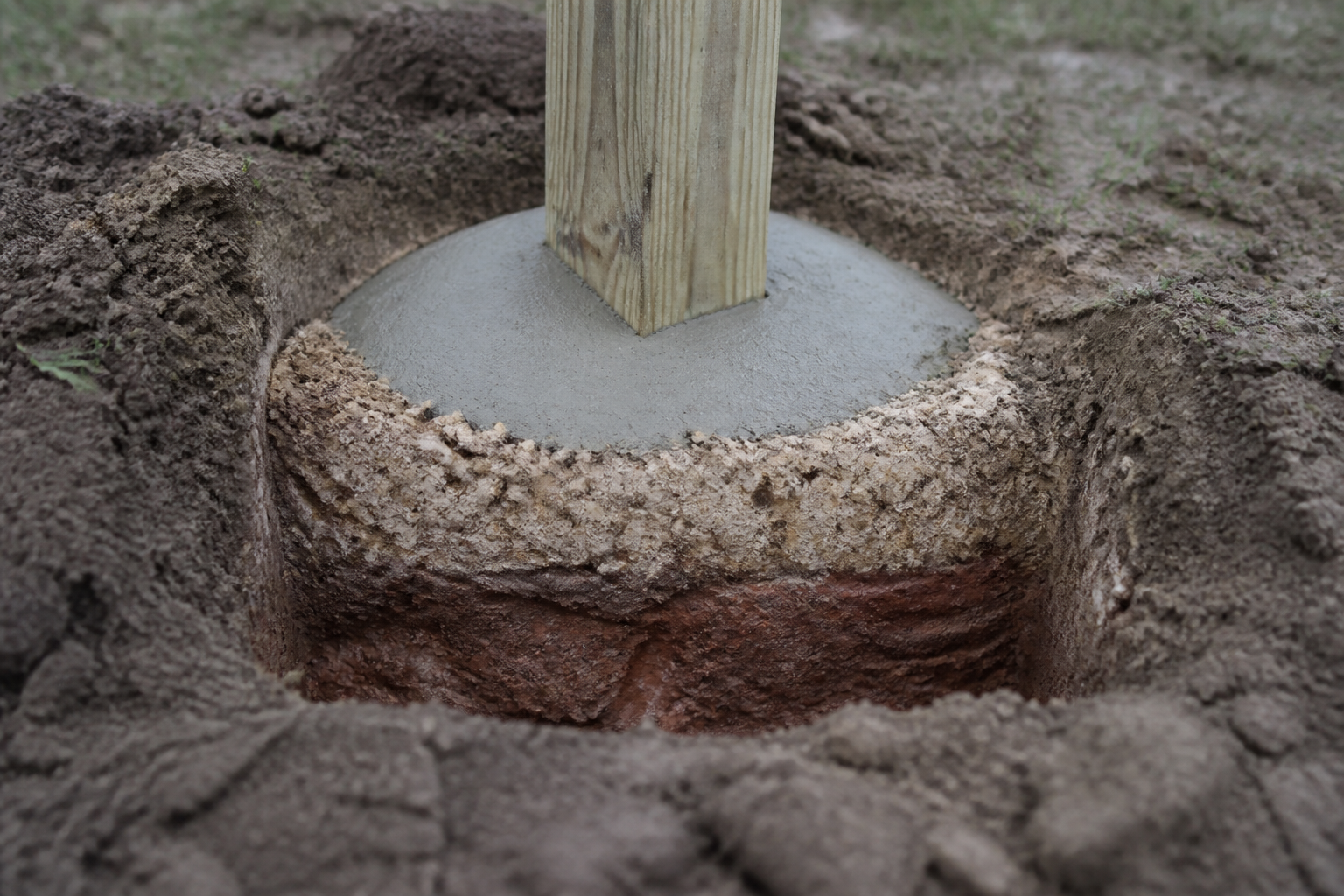
- A concrete collar poured level with, or below, the surrounding grade turns the hole into a catch basin. Crowning it above grade is the cheap fix and it costs nothing but attention.
- Calling 811 does not get your own buried lines marked. In North Carolina, water, sewer and storm drain are marked only to the meter or the right of way — the rest of your yard, which is exactly where a fence goes, is on you.
- Gate posts fail before fence posts because they carry a swinging cantilever load, not a static one. Ask about the gate posts specifically.
The eight-inch line
The dominant soil series across the Piedmont uplands here is Cecil. It is the type soil for this landscape, established from a profile in Franklin County, North Carolina, and the USDA’s Official Series Description for the Cecil series is public. It is worth reading the way a contractor reads it, which is as a list of what the auger is going to hit and in what order.
| Depth below grade | Horizon (USDA OSD, rev. 11/2025) | Texture and feel | What it means for a post |
|---|---|---|---|
| 0–8 in | Ap | Sandy loam, “very friable” | Digs easily. Holds nothing. A post set only this deep is standing in a flowerpot. |
| 8–26 in | Bt1 | Red clay, “firm; sticky, plastic” | The load-bearing zone. Also the zone that will not let water out sideways in a hurry. |
| 26–42 in | Bt2 | Red clay with yellowish-red mottles | Still clay. Mottling is a sign water has sat here seasonally. |
| Below 60 in | — | — | Seasonal high water table sits deeper than 60 inches, so a wet hole is not groundwater. It is rain that has not left. |
Two numbers from that page matter more than the rest. The first is the top of the Bt1 horizon at roughly 8 inches: that is where digging stops being easy and starts being work, and it is why a crew that quotes suspiciously fast on a Huntersville yard is worth a second question. The second is mean annual precipitation of 1,219 millimeters, which is 48 inches of rain a year landing on a soil that is mostly clay from ankle depth down.
Red clay does not heave. It holds water.
Ask around locally and you will hear that Carolina red clay swells when it gets wet and shoves fence posts out of the ground. It is a tidy story. The USDA rates the Cecil series shrink-swell potential as Low, and lists the seasonal high water table as deeper than 60 inches. Neither swelling clay nor a high water table is doing what people say it is doing.
The real mechanism is duller and more fixable. NC State Extension’s soils chapter describes clay behavior plainly: clay particles are “small and platelike, are easily aligned and can compact, especially when wet,” and compacted soils “have less infiltration, greater runoff.” An auger spinning in wet Bt clay does exactly that to the wall of the hole — it aligns and burnishes the clay it is cutting. You end up with a smooth-sided cylinder cut into a material that already drains slowly, and then you fill it with concrete and backfill loose topsoil over the top.
Water gets in from above easily, because the top eight inches are friable. It leaves through the sides slowly, because everything below eight inches is firm clay that has just been glazed by the auger. The post spends the wet half of the year standing in a bucket. Wood rots from the bottom of the collar upward. Steel and aluminum posts corrode where the concrete meets the water line. And the freeze-thaw cycles that do happen here work on saturated soil rather than dry soil, which is when they get a purchase on it.
What crowning the concrete actually does
This is the single cheapest thing a crew can get right and the easiest thing to skip when they are behind schedule. Concrete poured to grade, or slightly below it and then covered with backfilled soil, gives surface water a path straight down the post. Concrete finished above grade and sloped away from the post sheds that water before it ever reaches the wood or the steel.
It is not exotic and no one will charge you extra for it. It is a question of whether the crew finishes the collar or walks away from it. Carolina Fencing Solutions states its own standard on the homepage as “Posts set plumb in concrete, panels perfectly level” — plumb and level are the visible half. The collar is the half you only see when someone digs one back up.
If you are getting three quotes, ask each estimator to describe what the top of the concrete looks like when they leave. You will learn more from that answer than from the price.
811 marks the utility’s lines. Not yours.
North Carolina 811 is the state notification center and using it is not optional. Their guidance is that you contact 811 or 1-800-632-4949 three working days before you dig, and their FAQ is specific that member facility owners have “three full working days (excluding the day of notice)” to respond and mark. Plan the calendar around that, not around the weather.
The part that catches homeowners is what the free service does not cover.
“Water, sewer, and storm drain lines are only marked within the right of way or to the meter, and not on private property. Lines from the right of way or meter to the residence or business are private lines and you will need to contact a private line locator to have these lines located.”— North Carolina 811, Private Lines
Read that against where a fence actually goes. A fence follows the property boundary and cuts across the yard — which is the exact territory 811 leaves unmarked.
| Line type | Marked free by 811? | Where a fence line meets it |
|---|---|---|
| Primary power, gas, telecom | Yes, by the utility that manages it | Usually crossing the front or side of the lot |
| Water, sewer, storm drain | Only to the meter or within the right of way | The lateral from the meter to the house is unmarked |
| Secondary water, sewer, gas, electric | No — private lines | Detached garage, shed, outdoor kitchen, pool equipment |
| Irrigation, low-voltage lighting, pet containment | No — private lines | Almost always in the perimeter strip a fence occupies |
An irrigation main opened by an auger is a bad afternoon. A gas line to a grill island is worse. NC811 publishes a list of private line locators and is explicit that it does not endorse any of them, so hiring one is your call — but a contractor who raises the question before you do is telling you something useful about how they work.
Gate posts carry a different load
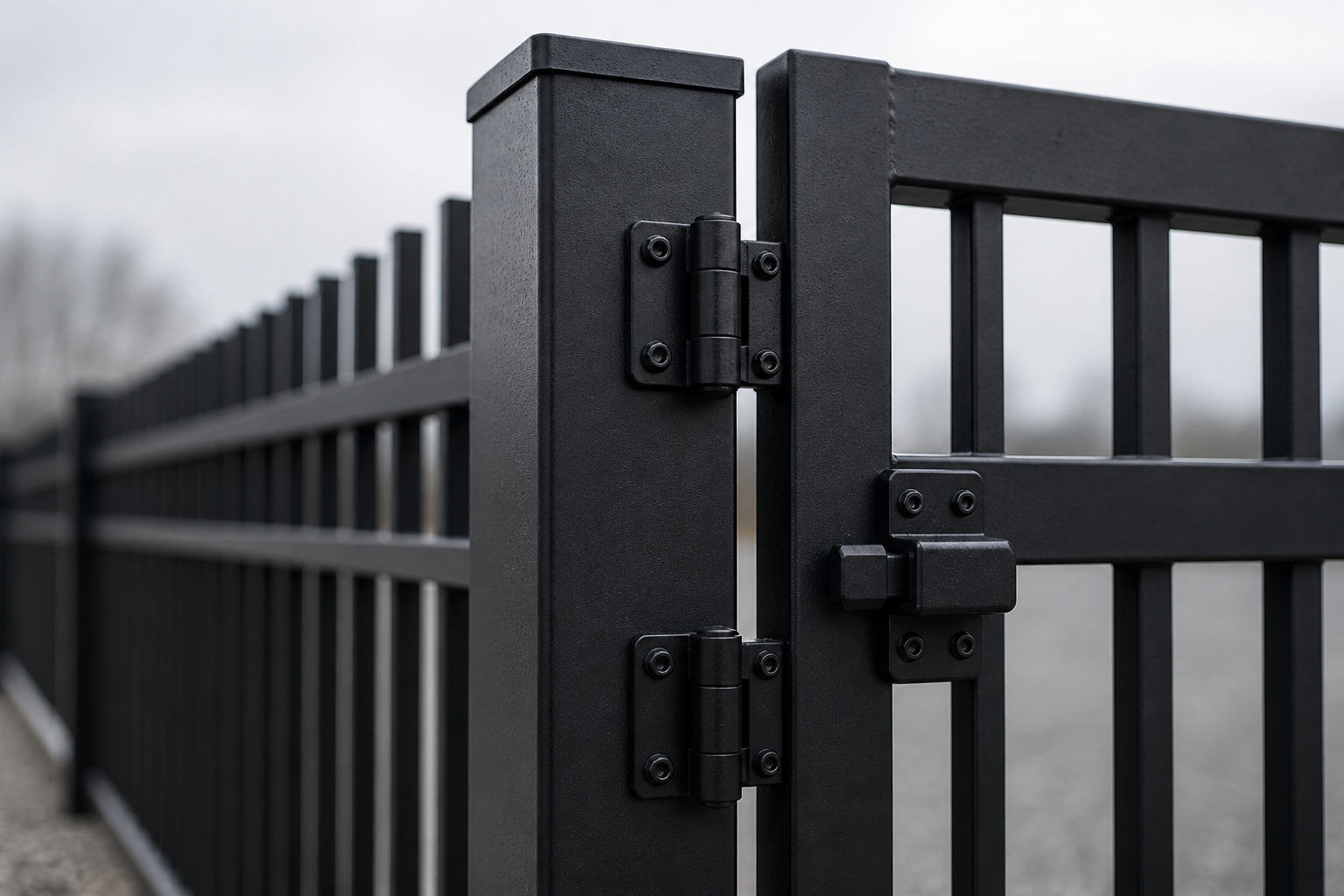
Every fence post carries a static load: it holds up panels that push evenly on both sides. A gate post does not. It carries a cantilever that swings, and the whole weight of the gate hangs off two or three hinge points on one face of one post. Every time the gate opens, that post gets a lever arm applied to it.
That is why gates sag first and why a sagging gate is usually a post problem rather than a hinge problem. In a soil profile like this one it compounds: the hinge post is being levered sideways in a hole whose walls are firm clay above and saturated clay below for months at a time. If a fence is going to move anywhere, it moves at the gate.
The fixes are structural and worth asking about by name: a larger-diameter hole and a deeper set for hinge posts than for line posts, a steel post inside a wood or vinyl sleeve on wide gates, and diagonal bracing on the gate frame itself so the frame does not rack independently of the post. If you are pairing aluminum fencing for a pool or patio with a matching gate, the aluminum panels are the easy part; the gate post is the engineering.
Five things worth asking on the estimate
- How deep are the line posts, and how deep are the gate posts? If those two numbers are the same, ask why.
- What does the top of the concrete look like when you leave? You are listening for “crowned” or “sloped away”, not “level with the grass”.
- Who calls 811, and when? Three full working days, excluding the day of notice. If the answer is “we’ll handle it the morning of”, the schedule is fiction.
- What happens if we hit an unmarked private line? Silence here is the answer.
- Where exactly is the property line coming from? A recorded plat, a pin found on site, or the neighbor’s memory of where the old fence was. Only two of those are worth building on.
None of these are gotchas, and a crew that installs fences in this soil every week will have quick, unbothered answers to all five. That is really what you are testing. If you are comparing estimates from more than one fencing company in Huntersville, the answers will separate them faster than the totals will.
What this article does not tell you
Two honest limits, because the alternative is guessing in public.
First, this article contains no Huntersville fence height limits, setbacks or permit thresholds. The Town’s ordinance pages were not readable at the time of writing, and a wrong number in an article like this is worse than no number. Confirm heights and setbacks with the Town of Huntersville planning department for your specific lot, and treat any blog that quotes them confidently — including any other blog on this site — as something to verify rather than rely on. Homeowners association review is a separate track again, and it is usually the longer one; there is a fuller treatment in our guide to HOA fence rules around Lake Norman.
Second, a soil series describes a landscape, not your yard. Cecil dominates the Piedmont uplands, but Huntersville lots on side slopes, near creeks, or on fill from the original build can look nothing like the profile above. The only way to know what is under a specific back yard is to open a hole in it, which is one more reason the estimate visit matters. Our Lake Norman installation overview covers the wider planning sequence.
Carolina Fencing Solutions works across Huntersville, Cornelius, Davidson, Mooresville, Denver, Concord and Charlotte. If you want a specific yard looked at, the number is (704) 778-4122.
Frequently asked questions
How deep should fence posts be set in Huntersville, NC?
Deep enough to be well into the firm clay rather than sitting in the loose top layer. The USDA profile for this area puts friable sandy loam in roughly the top 8 inches and firm red clay from about 8 to 42 inches, so a post that stops in the first horizon has nothing structural around it. Exact depth depends on fence height, post spacing, wind exposure and whether the post carries a gate, which is why a reputable installer will give you two different depths rather than one.
Does red clay really push fence posts out of the ground?
Not by swelling. The USDA rates the Cecil series that covers this area as low shrink-swell potential. What actually damages posts here is water sitting in a slow-draining hole through the wet months, which rots wood from the base of the concrete collar upward and corrodes metal at the water line. The fix is drainage and a crowned collar, not deeper digging alone.
Do I need to call 811 before a fence is installed?
Yes. North Carolina 811 asks for notice three working days before you dig, and member utilities have three full working days excluding the day of notice to mark. Normally your contractor places the ticket, but confirm who is doing it and on what date, because the waiting period sets the earliest possible start.
Will 811 mark my irrigation and my line to the detached garage?
No. Those are private lines. NC811 states that water, sewer and storm drain are marked only within the right of way or to the meter, and that lines running from the meter to the building are private and need a paid private line locator. Irrigation, low-voltage lighting and pet containment wire are all in the same category, and all three tend to live exactly where a fence goes.
Why does my gate sag when the rest of the fence is straight?
Because the hinge post is carrying a swinging cantilever load while every other post carries a static one. The gate’s whole weight hangs off one face of one post and levers it a little further every time the gate opens. In this soil that post is also being levered in a hole with slow-draining walls. Deeper and wider hinge-post footings, a steel core on wide gates, and a diagonally braced gate frame are the structural answers.
How do I find my property line before building a fence?
From a recorded plat or survey, or from iron pins located on site — not from where the previous fence stood and not from a neighbor’s recollection. A fence built on the wrong line is a legal problem, not a construction problem, and it is far cheaper to resolve before the holes are dug than after.
What is the best time of year to install a fence around Huntersville?
Any month is workable, but the ground is not equally cooperative. This area gets about 48 inches of rain a year on a clay-dominated profile, and augering wet clay both glazes the hole wall and makes it harder for the hole to drain afterwards. A dry stretch is better for the soil work; the tradeoff is that dry stretches are also when installers are busiest and lead times are longest.
Planning a fence in the Lake Norman area?
Get a written, itemized quote — usually within 48 hours. We handle permits, HOA review, and shoreline approvals.
Get my free estimateMore local guides

Fence Installation in Lake Norman: A 2026 Local Homeowner's Guide
Permits, HOA rules, soil, and lakefront setbacks — everything Lake Norman homeowners should know before installing a fence in Mooresville, Cornelius, Huntersville, or Davidson.
How Much Does a Fence Cost in North Carolina? (2026 Pricing Guide)
Real installed price ranges per linear foot for wood, vinyl, aluminum, and chain link in the Charlotte / Lake Norman area — plus the local cost drivers that move the number.
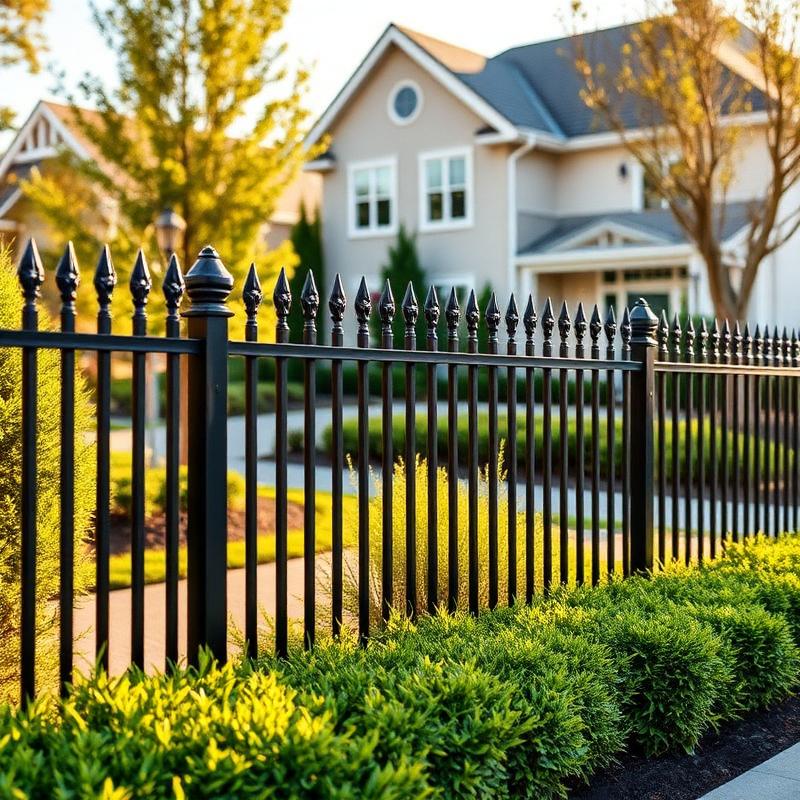
Best Fence Types for Mooresville & Huntersville Homes
The fence styles that actually hold up to NC humidity, summer storms, and HOA design standards in Mooresville, Huntersville, and Cornelius — ranked by what we install most.