
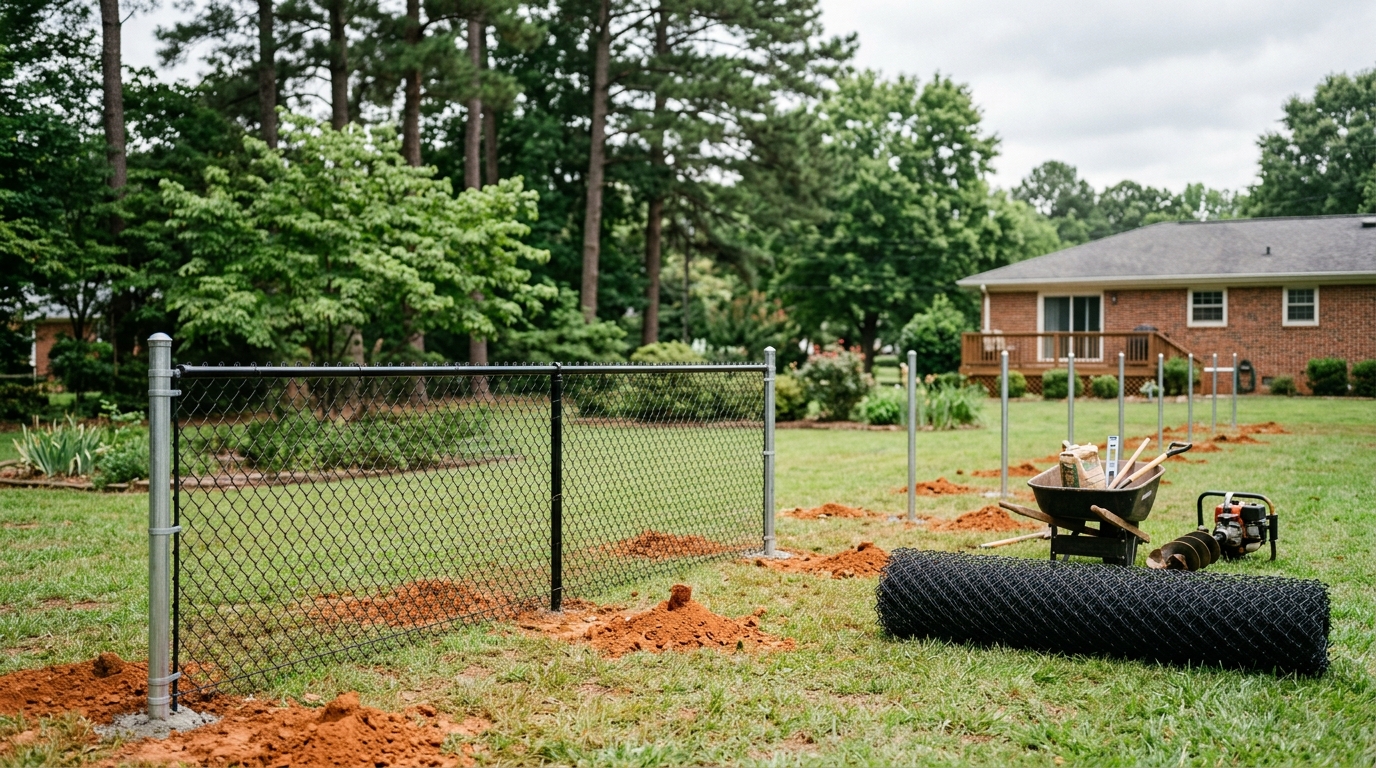
Chain link fence installation runs $8 to $40 per linear foot installed, with a typical band of $10 to $20, according to Angi's chain-link cost guide updated May 30, 2026. That is a national range, not a quote for your yard. Where a Lake Norman property lands inside it is decided by four things: how tall the fence is, which coating class the fabric carries, how many corners and gates the line has to turn, and what the auger finds below the topsoil.
This guide explains each of those four, with the published specification behind it. We do not publish a price for a yard we have not walked, so every dollar figure below is attributed to the third-party guide it came from and labeled as a national range. Our own numbers arrive as an itemized written estimate after a site visit. If you want the wider material-by-material picture first, that lives in our North Carolina fence cost guide.
Key takeaways
- Angi's cost guide (updated May 30, 2026) puts installed chain link at $8 to $40 per linear foot nationally, and a whole project at $1,297 to $3,587, average $2,419. National figures, not local quotes.
- Height costs more than the extra fabric. ASTM F567's minimum footing depth is 24 inches, plus 3 inches for every foot of fence height over 4 feet, so a 6-foot fence needs 30-inch holes before anyone prices the mesh.
- Line posts sit no more than 10 feet on center, but the fabric's tension is carried by terminal posts: ends, corners, gate posts and pull posts. Two yards with identical footage and different corner counts are not the same job.
- "Black vinyl-coated" is a polymer jacket over a metallic-coated steel core, and the gauge on the quote describes that core wire. Ask which ASTM F668 coating class you are being given.
- The Town of Davidson's planning ordinance allows chain link in rear yards only. Your HOA covenant is a separate document and can be stricter than the town.
Cost per linear foot by height
Published cost guides are useful for setting expectations and useless for setting budgets, because they describe the whole country at once. The table below pairs the per-foot ranges from Angi's 2026 chain-link fence cost guide with two things the guides leave out: how deep the holes have to be at that height, and how big the line posts have to be.
| Fence height | Angi national range, per linear ft | Minimum footing depth, ASTM F567 | Minimum line post OD, ASTM F1083 Group IA |
|---|---|---|---|
| 4 ft | $8–$20 | 24 in. | 1.900 in. |
| 5 ft | $9–$22 | 27 in. | 1.900 in. |
| 6 ft | $10–$29 | 30 in. | 1.900 in. |
| 8 ft | $12–$34 | 36 in. | 2.375 in. |
Two caveats on that table, both worth more than the numbers in it. The Angi column is national and includes markets with labor rates and soil nothing like ours. The post-size column comes from the CLFMI selection guide, which states the condition it was calculated under: 2-inch 9-gauge mesh, 105 mph wind speed, Exposure Category B, no icing. Change the mesh or the exposure and the minimum changes with it.
Why the last two feet cost more than the first four
Homeowners reasonably assume a 6-foot fence costs about half again what a 4-foot fence costs, because it is half again as much fabric. The framework does not scale that way. The CLFMI Product Manual, the specification manual published by the Chain Link Fence Manufacturers Institute, sets posts in concrete footings per ASTM F567 with a minimum depth of 24 inches plus an additional 3 inches for each 1-foot increase in fence height over 4 feet. Going from 4 feet to 6 feet does not add 3 inches of hole. It adds 6, on every post on the property.
Footing diameter moves too. The same specification calls for a minimum footing diameter of four times the largest cross section of the post, up to 4 inches outside diameter. Widening and deepening the same hole is a volume change, not a linear one, and it is paid for twice: once in the digging and once in the concrete, which has to reach a 28-day compressive strength of 2,500 psi.
Then the bracing threshold arrives. End, corner, pull and gate posts have to be braced and trussed for fences 6 feet and higher, and for 5-foot fences that have no top rail. A 4-foot backyard fence and a 6-foot one are not the same product with different mesh. The taller one carries a horizontal brace rail and a diagonal truss rod at every terminal, deeper and wider footings under every post, and above 6 feet a larger minimum line post as well.
The practical version, from the yard: the part of a chain link quote that never shows up as a line item is the last six inches of each hole. In Piedmont clay that is also the slowest six inches to dig, and there is one of them at every post.
Galvanized or black vinyl-coated
This is a choice that is easy to make on looks alone, and it is the one where the specification sheet matters most. Both finishes are covered by published ASTM standards, and both standards have classes. A quote that says "galvanized" or "black vinyl-coated" and stops has told you the color, not the coating.
Galvanized fabric is made to ASTM A392, Standard Specification for Zinc-Coated Steel Chain-Link Fence Fabric, whose requirements include a zinc coating weight class. The CLFMI manual gives the two: Class 1 at 1.2 oz/ft² and Class 2 at 2.0 oz/ft², and notes Class 2 is available in 9 and 6 gauge. Coated fabric is made to ASTM F668, which has three classes describing how the polymer is applied: Class 1 extruded, Class 2a extruded and adhered, and Class 2b fused and adhered. Their thicknesses are not equivalent.
| Question to put on the quote | Galvanized (ASTM A392) | Black vinyl-coated (ASTM F668) |
|---|---|---|
| What the coating is | Hot-dip zinc, applied before or after weaving | A polymer jacket over a metallic-coated steel core wire |
| How much coating | Class 1: 1.2 oz/ft². Class 2: 2.0 oz/ft² | Class 1 and 2a: 0.015 in. minimum at any point. Class 2b: 0.006 in. minimum |
| Maximum coating thickness | Not specified by weight class | Class 1 and 2a: 0.025 in. Class 2b: 0.010 in. |
| What the stated gauge measures | The steel wire itself | The metallic-coated core wire, not the finished outside diameter |
| Color reference | Not applicable | An ASTM F934 standard color |
Read the coating-thickness row twice. A Class 2b coating can legitimately be specified at 0.006 inches where Class 1 and Class 2a start at 0.015 inches. Both are ASTM F668. Both get called "black vinyl-coated" in a driveway conversation. One carries roughly two and a half times the minimum jacket of the other, and the difference is invisible until something scrapes it.
the wire gauge specified for polymer-coated wire is that of the metallic coated steel core wireCLFMI Product Manual, Section 2, Steel Chain Link Fabric
That sentence settles an argument that comes up on coated-fence quotes. When a coated fence is sold as 11-gauge, the 11 gauge is the steel underneath the black, not the black itself. So a coated 11-gauge fabric and a galvanized 11-gauge fabric are carrying the same wire, and the polymer is an additional layer rather than a substitute for zinc. It also means you cannot compare a coated fabric with a galvanized one by measuring the wire with calipers, which is exactly what people try to do.
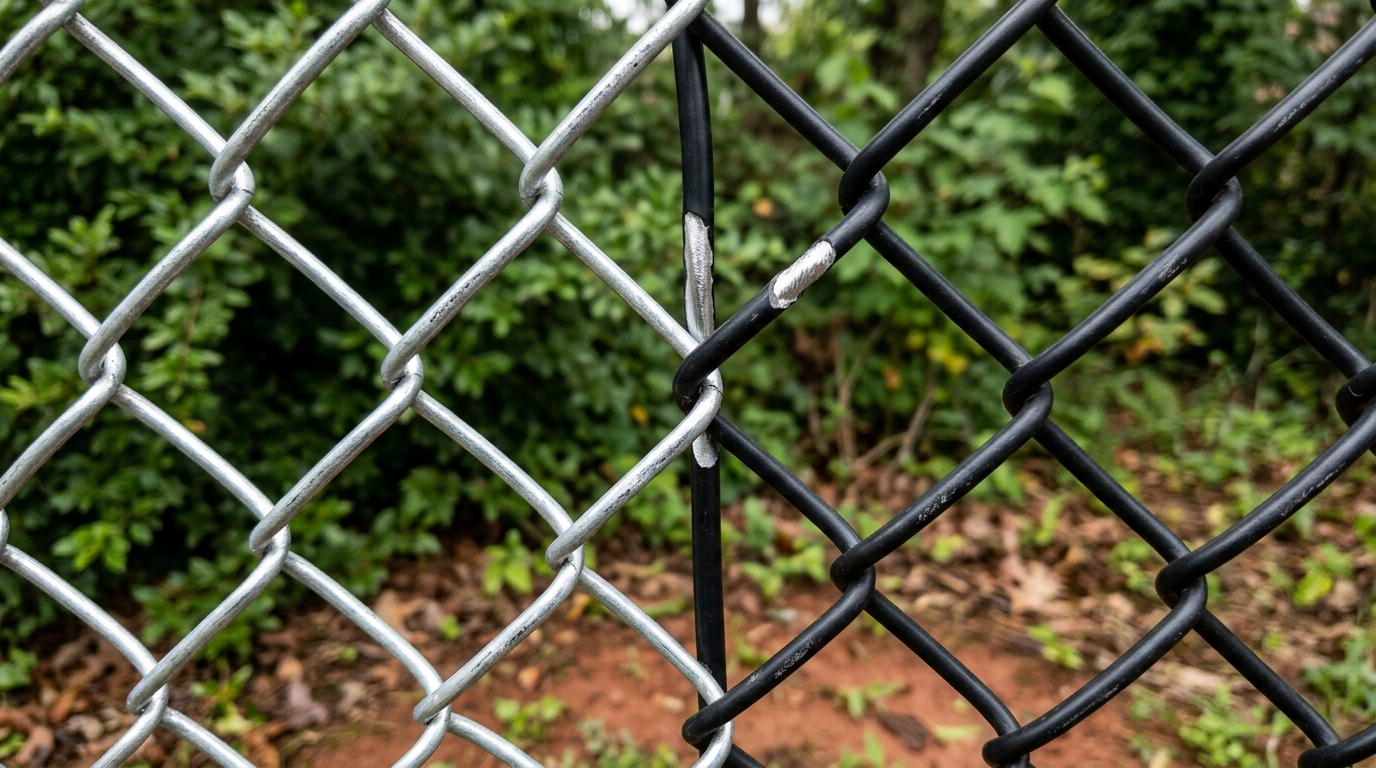
For what each finish looks like on a finished run, and the gauges and mesh sizes we stock, our chain link fencing page covers the residential and commercial grades side by side.
Corners, gates and clay: where the money actually goes
Here is the cost driver that no per-foot table has a column for. A chain link fence has two kinds of post and they do completely different jobs. Line posts are the intermediates, set no greater than 10 feet on center, and they hold the fabric up. Terminal posts are the ends, corners, gate posts and pull posts, and they hold the fabric tight. All of the tension in a run lands on them.
So the arithmetic that sets your price is not only linear feet. It is terminals. A straight 150-foot run along a back property line has two terminals, one at each end. Take the same 150 feet and wrap it around a patio, a corner of the house and an equipment pad, and it might have seven or eight. Same footage, same fabric, several more braced and trussed assemblies, several more oversized footings, several more hours. When two quotes for the same yard are far apart, count terminals before you assume somebody is padding.
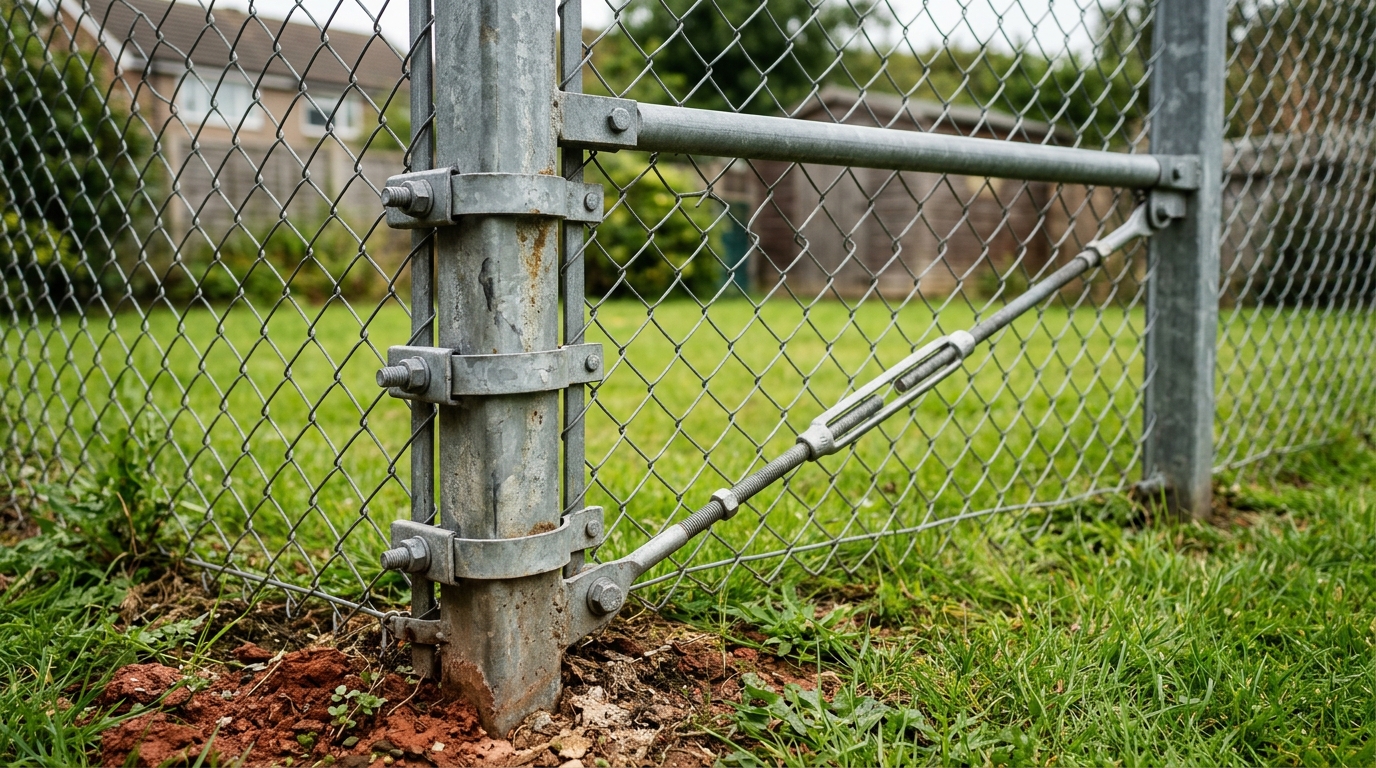
Three more line items follow from the same logic:
- Slope adds terminals. A pull post is defined as a terminal post used to accommodate a grade or placed at intervals along long stretches. A sloping back lot is not a straight run, whatever the tape measure says.
- Gates are their own spec. Gate posts require larger footings than line posts under ASTM F567, and they carry a swinging load every time the gate is used rather than a static one. Our gates page treats them as a separate conversation for that reason, and it is why gate count moves a quote more than gate width does.
- Drainage is a detail, not an upgrade. The specification calls for the top of each post footing to be crowned to shed water away from the post. In red clay that holds water, a collar poured flat or slightly dished turns every hole into a small reservoir.
Whether chain link is allowed where you live
Before any of the above matters, check that chain link is permitted on your lot, because around Lake Norman it is not universally allowed in every yard. The Town of Davidson is explicit. Section 4 of the Davidson Planning Ordinance design standards, under Fences, Hedges, and Garden Walls, states that in all planning areas fences in front of the building line shall be no greater than three feet in height and no more than two-thirds solid, fences behind the front building line shall be no greater than six feet, and "Chain link fencing is allowed in rear yards only." The same paragraph adds that on corner lots both facades fronting a street count as a front building line.
That is a town ordinance. Your HOA covenant is a separate document, it is enforced separately, and it can be stricter than the town on material, color and height. We do not publish a list of which Lake Norman communities permit chain link, because the only reliable answer is the one in your own recorded covenants and architectural guidelines. Reading them before the quote is the cheapest step in the whole project, and our guide to HOA fence rules around Lake Norman covers what an architectural review committee usually asks for.
One last sequencing note that saves money rather than spending it. If the fence line runs along a bank, a terrace edge or anywhere the grade is being changed, the ground work has to be finished and settled before posts go in. Posts set into fill, or along the crest of an unsupported slope, move with the soil, and a chain link run shows that movement immediately because the fabric is stretched taut between fixed terminals.
Chain link against aluminum over a long ownership
Two finishes homeowners often weigh against each other are black vinyl-coated chain link and black ornamental aluminum. Which one belongs on a given lot is usually decided by where the fence is going rather than by the day-one price. The more useful question over a long ownership is what each system asks of you afterwards, and where each one is allowed.
| Consideration | Black vinyl-coated chain link | Ornamental aluminum |
|---|---|---|
| Corrosion protection | Polymer jacket over a metallic-coated steel core, to ASTM F668 and its class thicknesses | A powder-coat finish over aluminum, which does not rust if the finish is breached |
| Most likely first failure | A breach in the jacket exposing the core, or a terminal post losing tension | Finish chipping, and hardware at gates |
| Repairing one damaged bay | Fabric is woven and cut to length, so a single bay can be cut out and re-stretched | Replacement is by the panel, and the color has to be matched to the run |
| Front-yard eligibility | Restricted in some jurisdictions. Davidson's ordinance allows it in rear yards only | Open-pattern and generally the safer material for a front or lakefront elevation |
| Privacy | None as installed, unless slats are added | None. Aluminum is not a privacy fence |
| What decides the lifespan | Coating class, and whether terminal posts hold tension | Footing depth at gate posts, and finish integrity |
Neither column is the winner. Chain link is the more repairable and the more affordable system, and it is genuinely well suited to a rear property line, a dog run or a back-of-lot boundary. Aluminum is the open-pattern material, and open pattern is what a front elevation asks for. The mistake is choosing on per-foot price and finding out afterwards that the material is not allowed where you wanted to put it.
When you are ready for a number that belongs to your yard rather than to a national average, we measure the line, count the terminals and gates, note the grade, and put it in writing. Request a free on-site estimate or call (704) 778-4122.
Frequently asked questions
How much does chain link fence installation cost per linear foot?
Angi's chain-link cost guide, updated May 30, 2026, puts installed cost at $8 to $40 per linear foot nationally, with a typical band of $10 to $20, and a whole project at $1,297 to $3,587. Those are national figures. A Lake Norman quote depends on height, coating class, terminal count, gates and site conditions, which is why we price from a site visit rather than a per-foot table.
Why does a 6-foot chain link fence cost more per foot than a 4-foot one?
Because the framework grows faster than the fabric. ASTM F567 sets minimum footing depth at 24 inches plus 3 inches for each foot of height over 4 feet, so a 6-foot fence needs 30-inch holes instead of 24-inch ones. At 6 feet and higher, every end, corner, gate and pull post also has to be braced and trussed, which adds a brace rail and a truss rod at each terminal.
Is black vinyl-coated chain link worth the extra cost over galvanized?
It depends on the class you are quoted and where the fence goes. Coated fabric is a polymer jacket over a metallic-coated steel core, so it is an added layer rather than a replacement for zinc. ASTM F668 Class 1 and Class 2a require a minimum jacket of 0.015 inches while Class 2b requires 0.006 inches, so ask which class the quote covers. Coated black also disappears visually against trees, which is often the real reason people choose it.
What gauge chain link fabric should a residential fence use?
The CLFMI Product Manual lists 2-1/8 inch mesh in 11-1/2 gauge as residential, 2 inch mesh in 11 gauge as residential and light commercial, and 2 inch mesh in 9 gauge as residential through industrial. Heavier gauge means more steel per wire: 9 gauge has a 1,290 lbf breaking strength against 850 lbf for 11 gauge and 750 lbf for 11-1/2 gauge.
How far apart should chain link fence posts be?
Line posts are set no greater than 10 feet on center between terminal posts. That maximum is the spacing, not a target, and wind exposure or heavier mesh can require closer spacing. Terminal posts, meaning ends, corners, gate posts and pull posts, are placed by the shape of the line rather than by a spacing rule, and they are what the fabric tension pulls against.
Does my HOA or town allow a chain link fence around Lake Norman?
That has two answers and you need both. The Town of Davidson's planning ordinance states that chain link fencing is allowed in rear yards only, and limits fences in front of the building line to three feet and no more than two-thirds solid. Your HOA covenant is a separate document that can be stricter than the town. Read the recorded covenants and architectural guidelines before you order anything.
What should a chain link fence quote spell out?
Fabric height, mesh size and gauge, and the ASTM coating standard and class: A392 Class 1 or Class 2 for galvanized, F668 Class 1, 2a or 2b for coated. Then footing depth and diameter for line posts and separately for gate posts, line post spacing, how many terminal posts are included and whether they are braced and trussed, gate count and width, and the length of the workmanship warranty.
Planning a fence in the Lake Norman area?
Get a written, itemized quote — usually within 48 hours. We handle permits, HOA review, and shoreline approvals.
Get my free estimateMore local guides

Fence Installation in Lake Norman: A 2026 Local Homeowner's Guide
Permits, HOA rules, soil, and lakefront setbacks — everything Lake Norman homeowners should know before installing a fence in Mooresville, Cornelius, Huntersville, or Davidson.
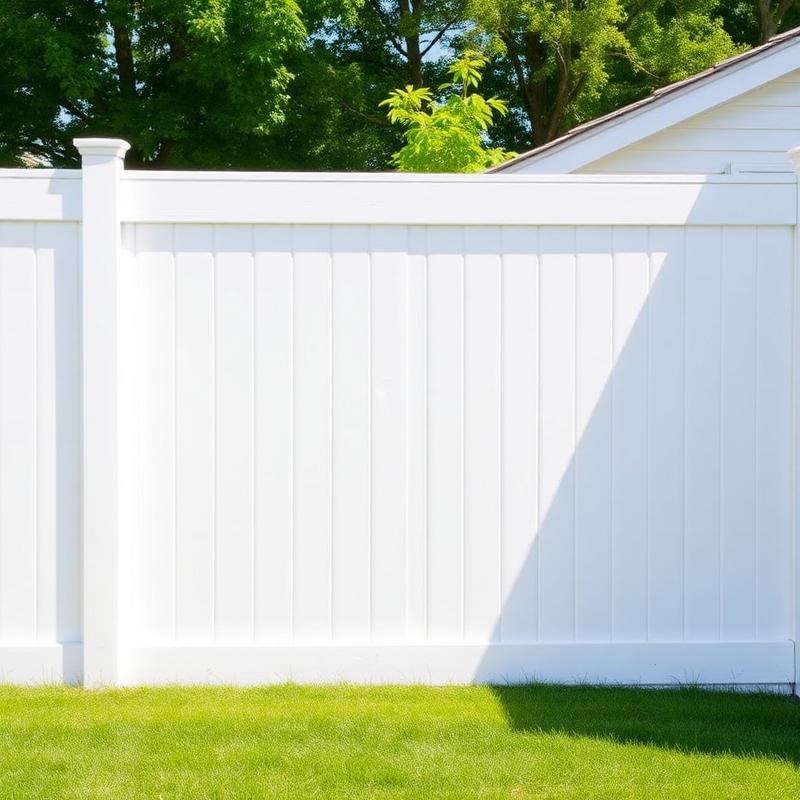
How Much Does a Fence Cost in North Carolina? (2026 Pricing Guide)
Real installed price ranges per linear foot for wood, vinyl, aluminum, and chain link in the Charlotte / Lake Norman area — plus the local cost drivers that move the number.
Best Fence Types for Mooresville & Huntersville Homes
The fence styles that actually hold up to NC humidity, summer storms, and HOA design standards in Mooresville, Huntersville, and Cornelius — ranked by what we install most.